Blog
How Are Underground Pipes and Wires Found Without Digging?
Why This Question Comes Up for Billings Homeowners
Homeowners usually ask this when they realize digging blindly is risky but also don’t want to tear up their yard just to “look.” In Billings, this concern is common because underground utilities are often shallow, rerouted, or undocumented, especially on older properties. The challenge is figuring out what is underground without causing damage in the process.
The good news is that modern locating methods allow utilities to be identified accurately without disturbing the ground.
The Core Idea Behind Finding Utilities Without Digging
Finding underground pipes and wires without excavation relies on detection, not exposure. Instead of uncovering utilities visually, locating methods identify physical properties such as conductivity, signal response, or subsurface disturbance patterns.
Each method works differently, which is why multiple techniques are often used together to confirm results.
Methods Used to Locate Underground Pipes and Wires
Different utilities respond to different detection technologies, so locating is not a one-tool process. The most common methods are best understood individually.
Signal-Based Line Locating
This method works by applying or detecting an electrical signal on conductive utilities. Metal pipes, tracer wires, and electrical cables can be traced by following the signal path underground.
This approach is commonly used for electrical lines, metallic gas pipes, and water lines with conductive components.
Tracer Wire Detection
Some non-metallic pipes are installed with tracer wires. Locating equipment follows the tracer wire rather than the pipe itself, allowing plastic gas or water lines to be identified without excavation.
The effectiveness depends on whether the tracer wire is intact and properly installed.
Ground-Penetrating Radar
Ground-penetrating radar detects changes in subsurface material by sending radar pulses into the ground and analyzing reflections. This allows non-metallic utilities, voids, and disturbed soil areas to be identified.
This method is especially useful when pipes or conduits lack tracer wires or conductive materials.
Visual and Surface Correlation
Locating also involves analyzing surface features such as meters, cleanouts, valve boxes, foundations, and utility entry points. These clues help confirm direction, depth changes, and connection paths when combined with detection data.
Why No Single Method Works on Its Own
Underground utilities vary widely in material, depth, age, and installation quality. Because of this, relying on one locating method often leaves gaps.
Some pipes are plastic with no tracer wire. Some electrical lines are abandoned but still present. Soil conditions in Billings, including freeze-thaw movement and mixed fill, can distort readings. Using multiple methods allows inconsistencies to be identified and resolved before digging begins.
How Accuracy Is Verified Before Any Digging Happens
Locating is not just about finding “a line.” It is about confirming that the detected feature is actually the utility in question and understanding its path.
Verification typically involves:
Detecting the utility using one method
Cross-checking location and direction with a second method
Comparing findings with surface features or known connection points
Adjusting for depth changes or signal distortion
This layered process reduces false positives and missed utilities.
Why Some Utilities Are Harder to Locate Than Others
Not all utilities respond equally to detection tools. Difficulty depends on both material and installation history.
Plastic pipes without tracer wires are harder to locate than metallic ones. Shallow utilities can blend with surface interference. Abandoned lines may still appear during detection even though they are no longer in use. Older installations may deviate from modern routing standards, especially on long-developed Billings properties.
These challenges are why experience and interpretation matter as much as equipment.
What Homeowners Often Misunderstand About Utility Locating
Many people assume locating produces a perfect underground map. In reality, locating provides best-available positions based on detection data and verification.
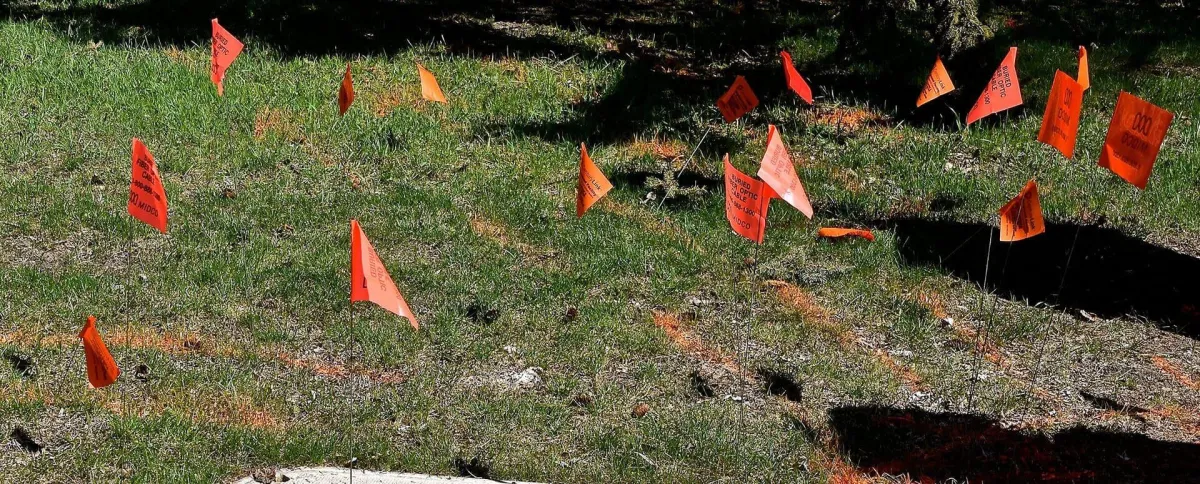
Utilities are rarely straight, evenly spaced, or installed at consistent depths. Locating identifies where lines run, how they change direction, and where uncertainty remains, allowing digging to proceed safely with informed caution.
Frequently Asked Questions About Finding Utilities Without Digging
Can underground utilities really be found without exposing them?
Yes. Modern locating methods identify utilities by their physical properties, not by visual exposure.
Does locating show exact depth?
Depth estimates are approximate. They help guide safe digging but are not exact measurements.
Can plastic pipes be located without tracer wires?
Yes, but it often requires radar-based methods rather than signal tracing.
Why do some lines appear where no records exist?
Many utilities were added, rerouted, or repaired without updated documentation, especially on older properties.
Is locating still useful if markings are already present?
Yes. Locating can confirm accuracy, identify private utilities, and detect lines not included in public markings.
Conclusion
Finding underground pipes and wires without digging is possible because modern locating focuses on detection, verification, and interpretation rather than excavation. By using multiple technologies and cross-checking results, utilities can be identified with minimal disruption and significantly reduced risk.
For Billings homeowners who want to understand what lies beneath their property before digging, working with experienced professionals like Last Call Locating Inc. helps ensure underground pipes and wires are identified accurately without unnecessary damage.

OUR SERVICES

CONTACT INFORMATION
Phone:
Business Hours:
Mon - Fri: 9:00 AM – 5:00 PM
Sat & Sun: Closed
OUR LOCATION
© 2025 All Rights Reserved | Last Call Locating Inc. | Privacy Policy